
Are the science wars over?
On the persistent crisis of humanities and knowledge

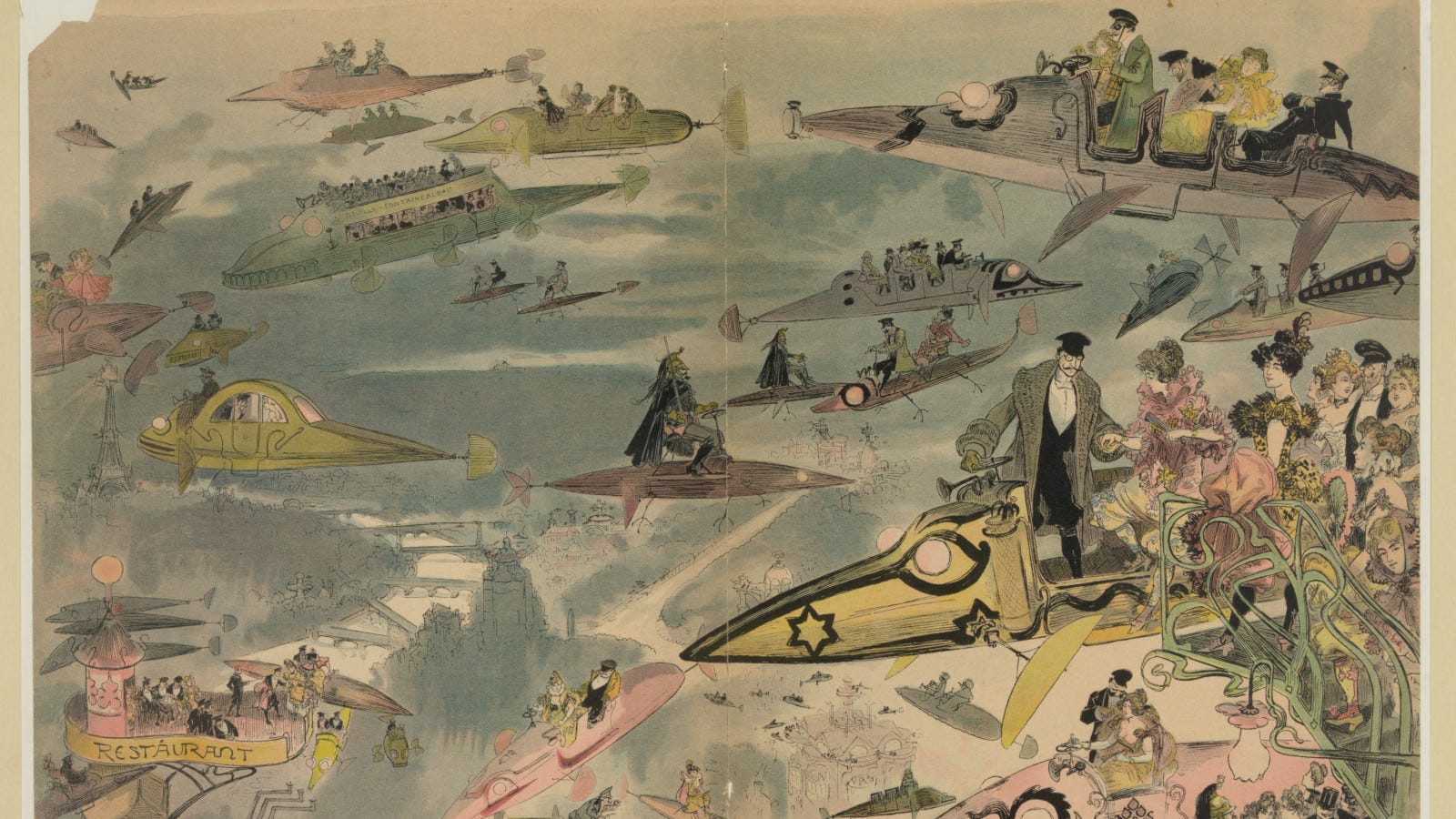
Human knowledge is, contrary to the popular belief, a field so vast and diverse, with rivers intersecting the most basic of our understandings of the world and ourselves. Yet in this vast, open world of knowledge, we can only see a part of it, yet feel another.
Language has been a primary tool for conveying knowledge - philosophy, literature, scientific writings - all using a medium. Yet even within that medium, we can’t define what a sentence means.
Killed by bricks
A title of a poem (it is)? Or an article on homocide? Or an analogy of everyday urban life? Truth be told, it can mean all of those things. And yet, it doesn’t always come down to figuring out the truth of that preposition (if the person was actually killed by bricks it would have been true, but in the context of a poem - not so much). There is no unified theory of meaning. Yes, we can deduct information and, given the context, infer meaning, but we cannot simply describe the framework within which this sentence would have been true but could also be not true.
So, if our language is limited, how about pictures? Worth a thousand words, yet lack atomised structure and recursivness of a language - they can’t convey meaning in the same way. They might contain multiple meanings - or none. Even a meaningless sentence like A rose is a part of world-machine is still contained within the molecular structure of a language - these words function like a machine, morphems carry meaning of individual particals even though they can’t correspond to the reality as we see. it.
So, reality. Simply put - is it a collection of phenomena (our experiences of reality) or is it external?
The former would be categorised as a postmodern thesis, while the latter would constitute a more traditionalist approach. This is where our story starts. Reality, meaning and truth - are they real? Or constructed? Or maybe - both?
Phisical and metaphysical
In the contemporary western philosophy, we often find two very distinct terms - continental and analytic philosophy. Both of them refer to a different schools - set of methods for philosophical inquiry - while both of them can deal with the same phenomena or reject one another alltogether.
I will not go into the distinction, but if you’d like to learn more on the origins of continental-analytic divide, I’d highly recommend Elie Anderson’s video on Overthink where she explains what are the typical demarcation lines when it comes to distinction between the two.
What I will do is point out two things - first is the poetic versus methodologically rigorous writing. While both use argumentation, the former would also use style as a means of communication. While Plato might speak (through Socrates) of justice, one would also be inclined to read his dialogues as a literary device, not only a medium through which Plato expresses his arguments.
So it’s philosophy, but what about science? As we know, science is not strictly defined. There is a scientific method but it is falable. Theories are being revised or are even made outdated by the standards of contemporary academia. However, even the scientific method, much like the continental-analytic divide, is also split on the issue of social and political sciences and natural sciences. Critical theory proved useful enough for sociologist, while being obscure to physicists who regarded science as rigorous and rooted in reality.
But how does one explain social phenomena with empirical evidence? Economics, the hard social science, has failed on multiple accounts when it comes to predictions, so even with the rigorous method, it’s still unable to produce results as someone would expect when studying classical mechanics. And even that isn’t enough to explain the most fundemental principles of reality - or humanity.
The science wars
During the 90s and early 2000s, the academic community has been at a civil war, but neither side could be defined in any terms that would constitute a proper definition. On one hand you have “realists” who argue that science is objective, while on the other there are “postmodernists” who argue that objectivity is corrupted1 by social structures. Dr. Fatima has done a great video essay on the topic, ranging from the most known affair, now called The Sokal Affair named after the physicist Alan Sokal who famously wrote a nonsensical paper and submitted it to a journal called Social Text, to other contemporary scientific hoaxes.
I’ll not go into much historical detail, but to be clear - Sokal had submitted his work to only one journal which had, in turn, accepted it, with editors believeing Sokal had done so in good faith. After its publishing, Sokal went all out on how this shows the lack of rigour in socal sciences and humanities. While Dr. Fatima gives good arguments on why Sokal is a bad experimentalist (compared to, for example, William M. Epstein2), I have to give some credit to Sokal and (his co-writer) Bricmont for highlighting the misuse of scientific jargon by some post-modern thinkers (such as Lacan or Deleuze).
But does that make their work nonsense? Sokal and Bricmont (in Fashionable Nonsense) do not claim to analyse the argumentation on psychoanalysis or philosophy, but merely point out the misuses of scientific jargon, mainly from physics and mathematics. This book, unlike his paper, has a thesis - to expose and highlight lack of intellectual rigour of some of the authors in the field. His paper, however, does not conceve of any thesis, with some parts being written as nonsensical on purpose.
And if we’re being honest, Sokal’s paper doesn’t prove anything - because he has not created a control group. Luckly, somebody, unintentionally, did.
Sokal in reverse
First of all, Social Text was not peer-reviewed at the time. Many people, even in academia, believe that peer-review is impenetrable. That, however, is not the case. If you read any publication you’re ought to find that some things pass peer-review even when they’re supposed to be caught by the reviewers. Even the double-blinded review where one doesn’t know the name of the other (reviewer or the author), can be falable and can let nonsense into the realms of science.
That’s what have happened with Bogdanov affair. Bogdanov brothers are known for hosting a TV show in France, writing a series of books - and for being a 4Chan meme. However, both of them hold PhDs in physics and mathematics. Alongside their thesis, brothers have published articles in 4 peer-reviewed jorunals. And, as Polšek points out:
At least three well known physicists, Roman Jackiw from Massachusetts Institute of Technology, Costas Kounnas from École normale supérieure Paris and Jack Morava from Johns Hopkins University, among other peers, reported favourably on Bogdanov brothers articles. (2008: 1025)
So how was physics, this rigourous field that relies on the assumption that the reality is objectiv, bitten back by Sokal-like hoax? Truth is, the brothers have denied it being a hoax, but a genuine attempt at theoretical physics.
To “fight back”, the scientific realists have decided to do the “Sokal squared”, that is to perform another stunt, this time known as the Grievance Studies Affair. So what point has the trio behind this hoax tried to prove? Well, as Beauchamp wrote for Vox:
Pluckrose, Lindsay, and Boghossian are not neutral scholars: All of them are critics of so-called identity politics and the social justice left more broadly. When I spoke to Lindsay on the phone, he told me openly that the project was born of a concern over “political correctness” run amok in the academy and the United States more broadly.
Their goal, in short, is to reveal the identity left as an emperor wearing no clothes: To show that the ideas you hear from liberal intellectuals, activists in #MeToo and Black Lives Matter, and even some Democratic elected officials are vacuous at best.
Even on the “political left”, people like well known stubborn intellectual Noam Chomsky have defended the work of Pluckrose, Lindsay and Boghossian as legit, while disregarding that this happens across all fields of scientific inquiry.
So where does that leave science today?
COVID-19 and the rise of internet pseudo-intellectualism
Let’s make something perfectly clear - there are assumptions that scientists make, there are proven theories backed by centuries of empirical data. There’s also a historical lineage of science and humanities that, like it or not, influences our current understanding of the universe and ourselves.
COVID-19 pandemic gave rise to a relatively new way of discourse - the internet (pseudo)intellectualism. Anti-intellectual movements have been shaped by the pandemic, especially in the early phases when scientific community was divided both regarding the method with which to combat this issue and the models on which to base their predictions. As it has been reported,
recent studies show public distrust of scientists is associated with uncertain and inconsistent scientific information on COVID-19. Kreps and Kriner (2020) conducted longitudinal surveys and found that COVID-19 predictive models and findings from scientific research often showed contradictory results due to limited data at the beginning of the pandemic. (Chen et al.: 2023)
The media hype in this new hyperreallity created a frenzie of epistemic metastasis, where bits of knowledge are not true or false by default - but are rather post-true or post-false, meaning that trust in scientific inquiry has dropped so low that it can be instrumentalised as a rethorical rather than empirical tool.
So this new era of science wars does not contain two sides of the debate, but rather it encompasses a social and political climate where science and humanities have come to be tools of political power.
Polšek has sumarised an overview of this debate:
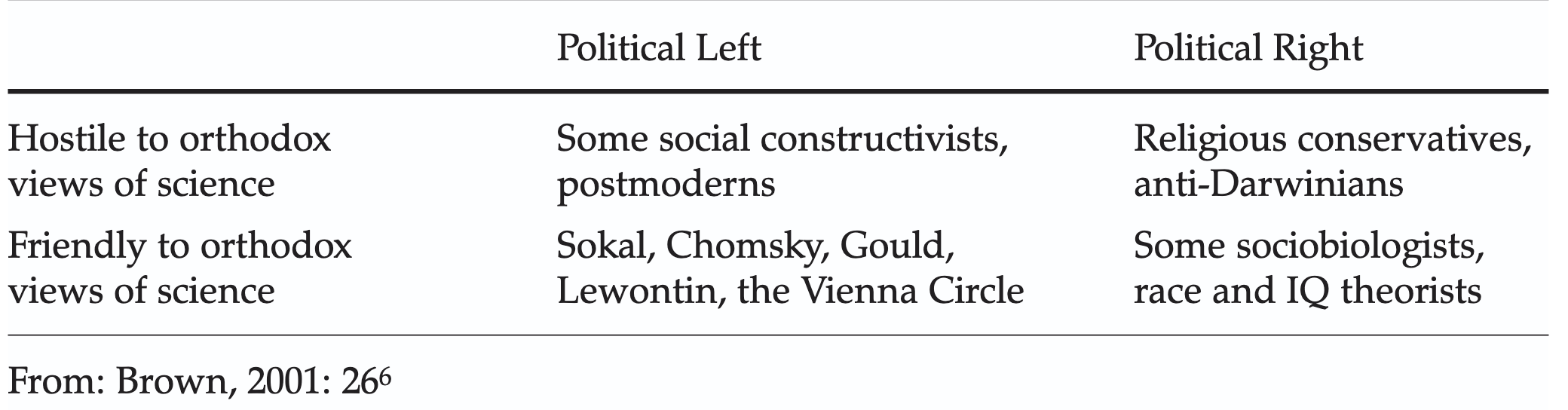
Science has long gone from being verifiable to falsifiable (many thanks to the revolution that Karl Popper had brought in his account of philosophy of science) and to finally accepting that its movements are not independent of the society (Kuhn).
So even the political orientation can affect the stance on certain issues. The aforementioned Vienna Circle gave rise to logical positivism, which in turn rejected areas like aesthetics and ethics as not being truly scientific. Their stated mission had failed, and ethics and aesthetics, alongside cultural studies, STS, and many more areas of inquiry are still alive today, with many schools of thought.
In the post-COVID world, knowledge is recursive in some way - it is produced by the very organism it tries to understand - the world around us. Be it physical reality or phenomenological account of reality, it still has shown to have limitations.
Crisis of humanities
In the times of crises, humanities (mainly philosophy, literary theory and cultural studies) experience the worst of it. Humanities have developed a long-standing tradition of a dialogue with the past, thus giving birth to new ideas and concepts. As Hegel famiously put the idea that freedom exists as a sort of string moving and shape-shifting through history (or Geist as he called it, lit. Ghost) within which reason rules, and Heidegger put Being in Time, we have come to understand that without acknowledging the past, we can’t move forward and produce new ideas.
I have felt the crisis of humanities myself, being a scholar of the arts (or I wish I was). My search for the lost time was, as I initially thought, a search for meaning. I wanted cognitivism and radical empiricism to be the ultimate explanation - theory that could finally give in and create a framework within which fiction and art can be understood.
But I, of course, failed. But my failure wasn’t without a consequence. I realised that in order to understand the aesthetic value, I’ll need to look elsewhere, without disregarding my initial theories. So, after spending years writing about aesthetic cognitivism - I’ve written an essay on courtroom drama and its implications on emotional engagement and ethical reasoning.
That was my personal journey, but even in academia, humanities are still regarded as second to physics or engineering. Society needs those fields, but it can’t be a society without culture. And without understanding the culture and social structures - where does it lead?
From my point of view, it leads us into a late state of fasicsm.
On misuse of aesthetics
In her essay The Beauty and Evil, Mary Devereaux discussed Triumph of the Will, a nazi propaganda movie that also encompasses what she infers as aesthetic value. Without taking much of a stance, many theories have been developed in what is now know as Ethical criticism of the art.
But let’s say you awake in 1930s after years of being frozen. You walk into a cinema and see this movie - does it move you? Maybe it does. Maybe you’re amazed by the cinematography.
We can infer stories into an image. And aesthetics means experiencing through our senses. In the apparent formation, there is inferred and created meaning. Triumph of the Will can evoke national pride or shame, but it can evoke personal emotions as well.
How many times have you heard about or seen a happy workplace? One that is full of all of the colours that the company is known for? Team buildings, company values presented by a company mascot (a pidgeon, for example)?
This is what I would describe as aesthetic dissonance. On the one hand, it alienates worker to emotionally attach ones own identity to the company (a money making machine), yet enforces labour as a merciless endeavour. You’re a family - until you are not.
Post-WW2 era in the US saw the rise of nuclear family identity - not just as a social concept (two parents, heterosexual couple with their children), but also in advertising. It was the way to live. A lifestyle of the 1950s:
The idyllic snapshots of the American dream family that 7-Up used in the ads all portrayed an eerily homogenous landscape of spacious suburban homes and smiling, prosperous, cheerful, Anglo-Saxon families enjoying fun times together in their suburban rumpus rooms and backyards. (sallyedelstein: 2014)

Does this image make you nostalgic? Why?
The answer is - aesthetics dissonance. We percieve the aesthetic pleasure as something that carries values of the time and not just the aesthetic properties, but also infers social reality onto you.
Conclusion
I’ve gone throgh many areas of inquiry in this short essay - all of them to show how paradoxical is to think in absolutes and give solutions as a false prophet of a utopia. Science has shown that it can’t deal with everything - not even with itself. There are problems with the scientific method, the definition of science and its place in the society.
Humanities have held this torch of the past, and continue to do so. However, when headlines such as Attack on Iran or War in Ukraine show up, society somehow loses its sense of identity and culture - thus shifting to rigid and “rigorous” methods of thinking.
By doing that, starting the “science wars” all over again, we lose the sense of belonging in the society that has produced a historical value - art, music, science and, of course - you. A valuable being that might not be remembered by the future, but will make a small step, maybe bigger than the one we made when we landed on the moon.
So keep thinking.
Further reading
Chen et al. (2023). Anti-intellectualism amid the COVID-19 pandemic: The discursive elements and sources of anti-Fauci tweets
Polšek, Darko. (2008). Who has won the science wars?
Dr. Fatima. (2024). the physicist who tried to debunk postmodernism
Hilgartner, Stephen. (1997). The Sokal Affair in Context
Beauchamp, Zack. (2018). The controversy around hoax studies in critical theory, explained
While I would prefer the term influenced, I used the term corrupted to emphasize the notion that objectivity is in itself problematic because knowledge doesn’t exist in a vacuum.
See more in Stephen Hilgartner (1997): The Sokal Affair in Context